

Contents
- 1 1. Anthropology: The Consistency King
- 2 2. Political Science & International Relations (PSIR)
- 3 3. Sociology: The Efficiency Specialist
- 4 4. Commerce & Accountancy / Economics
- 5 5. Literature Subjects (Specifically Hindi, Malayalam, or Punjabi)
- 6 The “Success Rate” Trap: A Word of Caution
- 7 Prelims & Mains Pointer
Choosing the right optional subject is arguably the most critical strategic decision in your IAS preparation. With the UPSC Mains optional papers accounting for 500 marks (roughly 25% of the total 2025 marks), your choice can be the difference between making the final merit list or missing out.
While “scoring” is subjective, the UPSC Annual Reports consistently highlight certain subjects where the ratio of recommended candidates to appeared candidates is significantly higher. For UPSC 2026, the trend points toward subjects that offer a blend of scientific scoring and General Studies (GS) overlap.
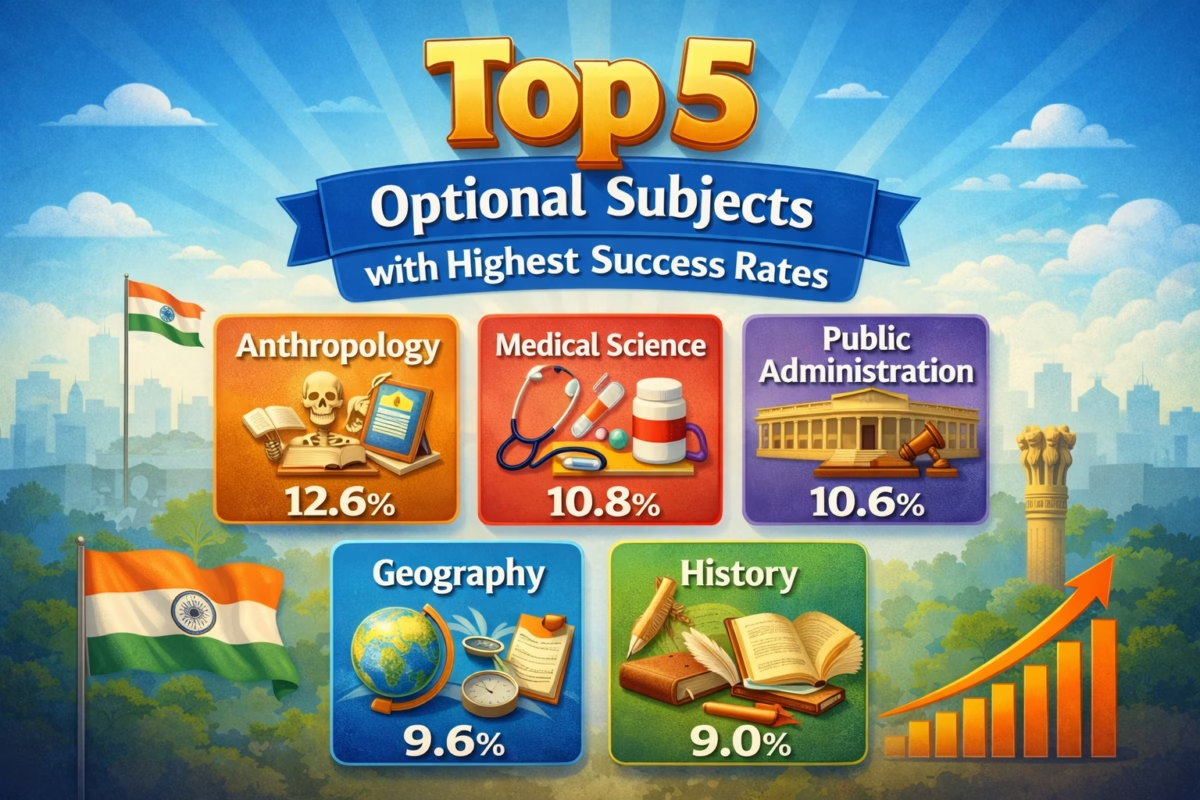
1. Anthropology: The Consistency King
Anthropology has emerged as a powerhouse for both science and humanities students. Its success rate remains high because the syllabus is compact, static, and scientific.
- Average Success Rate: 8% – 10%
- GS Overlap: Significant overlap with GS Paper I (Indian Society) and GS Paper II (Tribal Issues).
- Why it Ranks High: The answers are often objective. Using diagrams of skeletal remains or kinship charts allows for high precision.
- Recent Topper: Shubham Kumar (AIR 1, 2020).
2. Political Science & International Relations (PSIR)
PSIR is arguably the most popular choice for UPSC 2026 due to its massive synergy with the General Studies syllabus. It creates a “force multiplier” effect.
- Average Success Rate: 8% – 9%
- GS Overlap: Covers nearly 70% of GS Paper II (Polity, Constitution, and IR) and provides a strong foundation for the Essay Paper.
- Key Advantage: It keeps you updated with current affairs, which is vital for the Personality Test (Interview).
- Recent Topper: Shakti Dubey (AIR 1, 2024).
3. Sociology: The Efficiency Specialist
For aspirants seeking a manageable syllabus that can be completed in 4-5 months, Sociology is the top contender. It is highly relatable and helps in developing the “sociological imagination” required for social justice topics.
- Average Success Rate: 9% – 10%
- GS Overlap: Direct relevance to GS Paper I (Social Issues) and GS Paper IV (Ethics case studies).
- Why it Works: The concepts are easy to grasp even for beginners, and the resource availability (like NCERTs and standard IGNOU notes) is excellent.
4. Commerce & Accountancy / Economics
While these are “technical” optionals, they consistently boast some of the highest success rates—often exceeding 12%—because they attract specialized candidates.
- Success Rate: 10% – 15% (Highly variable based on the year).
- GS Overlap: Economics has a high overlap with GS Paper III (Indian Economy).
- UPSC Perspective: These subjects are “low risk, high reward” if you have a background in them, as the marking is more objective compared to purely humanities subjects.
5. Literature Subjects (Specifically Hindi, Malayalam, or Punjabi)
A hidden gem in the UPSC statistics is the performance of Literature Optionals. Because fewer candidates opt for them, the competition is less “crowded,” and the success rates are often surprisingly high.
- Average Success Rate: 10% – 18% (Subject-specific).
- GS Overlap: Minimal, but the preparation burden is lower than Geography or History.
- Expert Tip: Choose this only if you have a genuine command of the language and its literary nuances.
Comparative Success Rate Analysis (Latest Trends)
| Optional Subject | Approx. Success Rate (%) | GS Overlap Synergy | Preparation Time |
| Anthropology | 9.2% | Moderate | 4-5 Months |
| PSIR | 8.5% | Very High | 5-6 Months |
| Sociology | 9.8% | High | 4 Months |
| Economics | 12.1% | High (GS III) | 6 Months |
| Literature | 12% – 15% | Low | 4-5 Months |
The “Success Rate” Trap: A Word of Caution
As a UPSC Success strategist, I must warn you: A high success rate does not guarantee individual success. For example, Medical Science often shows a 15%+ success rate, but only because qualified doctors attempt it. If you choose an optional solely based on trends without interest, you will struggle during the grueling Mains Answer Writing phase.
3-Step Selection Framework for 2026:
- Interest: Can you read this subject for 6 hours straight?
- Resources: Are standard books and test series easily available?
- Background: Does it align with your graduation or current GS preparation?
UPSC Success Perspective:
In the 2024 results, we saw toppers from diverse backgrounds—from PSIR to Electrical Engineering. This proves that while success rates provide a macro-view, your depth of preparation and conceptual clarity are the ultimate deciders of your rank.
Prelims & Mains Pointer
For Prelims 2026:
- Remember that your optional choice should ideally complement your GS I (Geography/History) or GS II (Polity) preparation to save time during the “Golden Period” between Prelims and Mains.
- Note the trend: UPSC is increasingly asking analytical questions in Prelims that require the deep conceptual understanding usually gained during optional study (especially in Economics and Polity).